
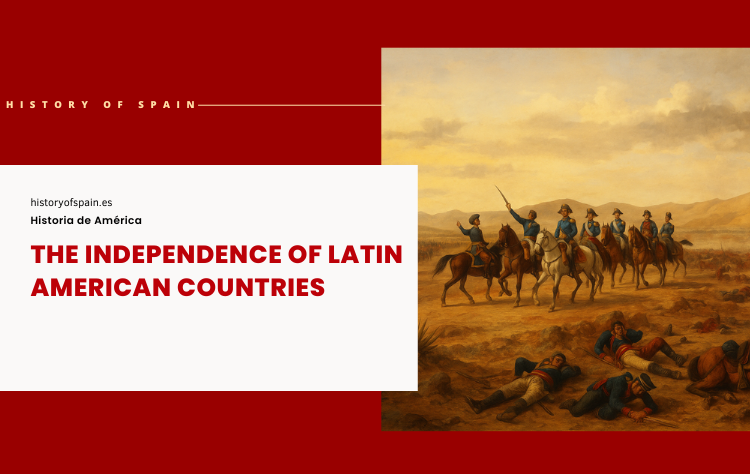
The independence of Latin American countries was a long and uneven process that brought an end to more than three centuries of Spanish colonial rule in the Americas. Between 1808 and 1833, the former colonies began to organize themselves as independent republics, facing internal conflicts, battles against royalist forces, and the difficult task of building a new political order.
This phenomenon cannot be explained by a single cause nor does it follow a uniform chronology. It was the result of multiple factors—political, economic, social, and ideological—that converged in a turbulent international context. The Napoleonic Wars, the crisis of legitimacy in Spain, the rise of Enlightenment ideas, and the aspirations of the Creole elites all came together in a continental movement that forever changed the history of the Americas.
A Continental Movement that Transformed the Americas
The independence of Latin America did not emerge from a single uprising, but rather from a series of parallel processes that took place in different regions of the continent. It was a deeply complex phenomenon involving everyone from peasants to military leaders, as well as merchants, clergy, women, enslaved people, and Indigenous communities.
The campaigns of José de San Martín in the Southern Cone, the resistance of Simón Bolívar in the Andes, and the popular uprisings in Mexico reveal the many faces of a process as diverse as the territory it encompassed. Each nation forged its own identity amid wars, alliances, and uncertainties, resulting in the birth of more than a dozen new sovereign states, each with its own contradictions and challenges.
A Continental Movement that Changed History
The independence of Latin American countries was not a single event nor a conventional war. It was a series of political and social processes that unfolded over more than two decades, starting in the early 19th century, with consequences that still resonate today. Across the continent, entire peoples rose up to break free from centuries of colonial domination, driven by new ideas, long-standing grievances, and a historic opportunity that seemed unrepeatable.
First Creole juntas and different paths to emancipation
It all began in 1808, when news of Napoleon’s invasion of Spain and the abdication of Ferdinand VII reached the Americas. The Spanish throne, a symbol of authority, was thrown into question, and in that power vacuum emerged the first Creole governing juntas, which initially acted in the name of the king but gradually began to challenge the colonial system itself.
What followed was not a uniform revolution. In each territory, events took different directions. José de San Martín’s campaign in Argentina, Chile, and Peru achieved significant progress with a relatively structured organization in the south. In Mexico, the uprising was more violent and prolonged, marked by strong ecclesiastical and popular leadership. And finally, in the Andean region, Simón Bolívar led a complex movement that combined idealism, bold military strategies, and necessary alliances to advance in a divided region.
Independence was, at the same time, a war, a negotiation, and a transformation. It was not only a conflict between patriots and royalists. There were also internal disputes, struggles between provinces, and deep debates about the kind of nation that should emerge after breaking with Spain. In this sense, independence was both a liberation and a starting point, full of uncertainties.
Today, it is difficult to understand the modern history of Latin America without going through these decisive years. The flags that fly, the current political systems, the anthems, and even territorial disputes all have their roots in this process of emancipation. It was the moment when Latin America began to see itself as a group of sovereign nations, although the path toward stability would be much longer and more complex.
▶ You might be interested in: Hernán Cortés and the Conquest of Mexico
Deep causes of the American emancipation
The independence of Latin American countries was the result of a long historical gestation. It did not arise from a single event, but from the accumulation of social, economic, political, and ideological tensions that, over centuries, eroded the foundations of the colonial system. From the 18th century onward, these tensions intensified, giving way to a highly complex emancipation process.
Ideological factors: the impact of new ideas
Enlightenment thought, born in Europe, reached America through banned books, gatherings and intellectual networks. Ideas such as popular sovereignty, the separation of powers, or the rights of man began to circulate among the Creole elites. The independence of the United States in 1776 and the French Revolution in 1789 showed that a change of regime was not only possible, but legitimate. This new vision of power contrasted with the absolutist model imposed from Madrid.
Economic and social factors: a system in crisis
The colonial economic model favored the metropolis to the detriment of the colonies. The trade restrictions imposed by Spain prevented the development of a strong local economy. The Creole elites, despite their wealth and influence, were systematically excluded from high administrative positions, which were reserved for peninsulares. Added to this were deep social inequalities, with a caste system that marginalized Indigenous peoples, mestizos, and Afro-descendants. This structural imbalance generated a persistent unrest that, over time, became unsustainable.
The political trigger: the crisis of the Spanish monarchy
In 1808, Napoleon’s invasion of Spain and the abdication of Ferdinand VII triggered an unprecedented crisis. The imposition of Joseph Bonaparte as king was seen in the Americas as a break in the legitimate order. The colonies, in the absence of a legitimate monarch, began to organize governing juntas in the name of the captive king. However, these juntas quickly evolved toward more radical positions, eventually leading to openly independence-oriented proposals.
Key events in the struggle for Latin American independence
The road to independence in Latin America was neither uniform nor simultaneous. It was a succession of uprisings, political decisions, and military campaigns that unfolded over more than twenty years, from northern Mexico to the southern Andes. Each region experienced its own process with its own pace, actors, and circumstances. Some territories achieved rapid emancipation, while others faced long conflicts before attaining sovereignty.
The following table offers an overview of the most representative milestones that marked this foundational stage in the continent’s history:
| Year | Relevant event | Region | Historical significance |
| 1811 | First cry for independence in Central America | El Salvador | José Matías Delgado raises his voice against colonial rule, opening the door to change. |
| 1815 | Bolívar takes refuge in Haiti | Caribbean | After several setbacks, Bolívar seeks support to relaunch the independence cause. |
| 1816 | Haitian military support for the liberation campaigns | Haiti | Alexandre Pétion offers support on the condition that slavery be abolished in the new states. |
| 1816 | Decree of emancipation of slaves in Venezuela | Venezuela | Bolívar fulfills his commitment to Haiti and takes a decisive step toward social justice. |
| 1821 | Signing of the acts of independence | Mexico and Central America | The first official independences are consolidated in several territories. |
| 1825 | Fall of the last royalist strongholds | Peru and Bolivia | The Spanish resistance in South America comes to an end, sealing the region’s emancipation. |
A sequence full of contrasts
Not all independence processes advanced at the same pace or with the same outcomes. In territories like the United Provinces of the Río de la Plata, separation from Spain was consolidated early on, with stable political leadership from 1816. In contrast, in regions such as Peru or Bolivia, the conflict dragged on for almost another decade until the last royalist strongholds were defeated.
This panorama shows that independence was not a simultaneous or automatic phenomenon. It was, instead, a prolonged and uneven struggle, shaped both by the internal interests of each region and by the international shifts of the time.
▶ You might be interested in: Francisco Pizarro and the Conquest of Peru
Revolutionary echoes from Mexico: when the clergy raised the banner of freedom
In the heart of New Spain, what we now know as Mexico, the desire for independence did not arise from a professional army or the military elite, but from the unexpected voices of those who, until then, had guided their people from the pulpits. One of them was Miguel Hidalgo y Costilla, a priest with deep social concerns and Enlightenment influences.
In the early morning of September 16, 1810, in the small town of Dolores, Hidalgo rang the bells of his parish to summon the people. His speech was not a homily, but a fiery call against colonial oppression. What began as a protest against abuses of power soon turned into a massive uprising that challenged the authority of the viceroyalty.
Although his movement was suppressed and he was captured shortly thereafter, his ideas took root with great force. One of his followers, the priest José María Morelos, took up the cause with a more structured vision. Morelos understood that independence alone was not enough if it was not accompanied by political and social transformation. That is why, in 1813, he promoted the Congress of Chilpancingo, where independence was declared and the “Sentimientos de la Nación” were drafted—an essential document advocating popular sovereignty, the abolition of privileges, and equality of all citizens before the law.
Both were executed, but their names remain etched in the collective memory as symbols of the beginning of a new era. Their actions not only laid the foundations for Mexican independence but also sparked a profound debate on justice, identity, and freedom that still echoes two centuries later.

Visual imagination, national symbols, and ideological contradictions
The birth of the tricolor flag
In 1806, during his expedition through Ocumare, Francisco de Miranda waved for the first time a flag with yellow, blue, and red stripes. Inspired by Enlightenment ideals, he aimed to give the independence movement a powerful visual identity. Although that campaign failed militarily, the symbol endured. Today, Venezuela, Colombia, and Ecuador share that chromatic legacy.
This fact shows how national symbols emerged from a mix of ideological conviction and the need for cohesion during times of upheaval.
Bolívar and the idea of an imperfect republic
Although Bolívar is remembered as a defender of the republic, he also expressed doubts about the viability of a purely democratic system in a torn continent. In private letters, he even proposed a constitutional monarchy or lifelong presidencies as a way to ensure stability.
His ideas, harshly criticized by figures such as Francisco de Paula Santander, reflect a constant tension between revolutionary idealism and the complexity of the historical moment.
The forgotten faces of freedom
Beyond the most recognized leaders, thousands of women played an active role in the independence process. In Peru, Rosa Campuzano worked as a spy and collaborator of San Martín, while in Mexico, Josefa Ortiz de Domínguez was key in the Querétaro conspiracy.
Many others, from behind the scenes, served as nurses, messengers, logisticians, or even fighters, playing crucial roles that rarely appear in history books.
The struggle of Indigenous peoples and Afro-descendants
Patriot ranks were also filled with Indigenous people and freed slaves, many of whom fought with the hope of improving their living conditions or gaining the promised freedom. However, after independence, much of their aspirations were sidelined.
The new republics preserved many of the social hierarchies inherited from the colonial period, leaving unanswered the demands of those groups who had contributed so much to the revolutionary cause.
Invisible protagonists who also shaped history
Not all the protagonists of independence are featured in statues or textbooks. In El Salvador, José Matías Delgado led the First Cry of Independence in 1811 and signed the 1821 act. Alongside him, names like Manuel José Arce or María Feliciana de los Ángeles Miranda (who led local uprisings) provided key leadership at the community level.
Alexandre Pétion himself, beyond his role as Haitian president, left a profound legacy as a silent strategist who championed a more egalitarian and emancipated Latin America.
A continent with broken unity
One of Simón Bolívar’s aspirations was to build a united Latin America, strong in the face of new foreign threats. His dream briefly materialized in the Gran Colombia, which included the present-day territories of Colombia, Venezuela, Ecuador, and Panama. However, that unity was short-lived. Regional differences, the conflicting interests of the elites, and the absence of solid structures soon fragmented that project, leaving the new states immersed in decades of internal conflict, caudillismo, and external dependence. Many of the challenges Latin American countries face today have their roots in that early rupture of continental integration.