If you are a teacher of the History of Spain in the 2nd or 3rd year of Secondary Education, we know you are looking for tools that make your lessons more dynamic, engaging, and easier for your students to understand. On our website, we have gathered a wide variety of educational history resources to help you explain historical events, figures, and movements in a visual, accessible, and entertaining way.
Below, we show you the different categories we offer and how you can use them in the classroom to bring history to life.
History: a complete timeline to put every topic into context
One of the greatest challenges in teaching history is helping students connect different periods and understand how events evolved over time. In our History of Spain section, you will find a complete timeline of Spanish history, from Roman Hispania to the present day.
Each period is explained clearly and accompanied by educational videos and written content that can help you structure your lessons. Some of the materials you may find most useful include:
- The Spanish Inquisition: detailed explanations and historical documents that allow you to discuss this topic in class.
- The Spanish Civil War: an analysis of its causes, development, and consequences, with audiovisual materials that make it easier for students to understand.
You can use these educational resources to support your explanations or as tools to encourage understanding in the classroom and make lessons more enjoyable for your students.
► You can find resources like this:
Historical figures: biographies that inspire
History is often better understood when it is humanized, which is why we have created a section on historical figures who have shaped the course of Spain. From kings and conquistadors to intellectuals and revolutionaries, here you will find biographies that can help students connect with history in a more personal way.
Some notable figures include:
- El Cid: his role in the Reconquista and his impact on literature.
- Isabella I of Castile: her influence on the unification of Spain and the discovery of the Americas.
- Hernán Cortés: a conquistador from Extremadura whose role is essential for understanding Spain’s expansion in the Americas and its historical consequences.
You can use these biographies to develop classroom activities, ask students to give presentations, or analyze related historical sources.
► You can find resources like this:
Cities of Spain: the stage of history
Cities are witnesses to the passage of time, and in our Cities of Spain section, teachers will find information about the historical legacy of different places.
Each city includes detailed descriptions of its monuments, historical development, and relevance across different periods. Some interesting options to explore in class include:
- Toledo: the Visigothic capital, a key city in the Reconquista and a symbol of coexistence between cultures.
- Cáceres: a UNESCO World Heritage city with a medieval old town, known for its Renaissance palaces and its important role during the era of the conquest of the Americas.
- Seville: a major hub of trade with the Americas in the Early Modern period, with iconic monuments such as the Giralda, the Alcázar, and the Torre del Oro.
You can use these educational resources for projects in which students research the history of their own city or to prepare educational field trips.
► You can find resources like this:
Spanish literature: the evolution of letters
Literature reflects society in every era, and in our Spanish Literature section you will find analyses of the most important works and their historical context.
Some key works that may interest you include:
- Spanish poetry in the Middle Ages and the Spanish Golden Age, with authors such as Garcilaso de la Vega, Luis de Góngora, and Francisco de Quevedo.
- Don Quixote and its impact on world literature.
- The Generation of ’98 and its critical view of Spain in its time.
These resources will help students understand how literature has been shaped by the social and political changes of each era.
► You can find resources like this:
Spanish art and architecture: a visual journey through history
Art and architecture have witnessed Spain’s historical changes. In our Spanish Art and Architecture section, you will find detailed analyses of the most representative styles and movements.
Some of the highlights include:
- Romanesque art and Gothic: their influence on cathedrals and monasteries.
- The Spanish Golden Age and the Baroque: artists such as Velázquez and Murillo.
- Modernisme and Dalí: the artistic revolution in the 19th and 20th centuries.
These visual resources will allow you to show students the evolution of art in Spain and its connection to history.
► You can find resources like this:
Turn history into an educational experience
At History of Spain, we strive to offer you the best educational history resources to make your lessons more interactive and engaging. We know history is not just a list of dates and names, but a fascinating story that deserves to be told in an exciting way.
We invite you to explore all our content and use it to help your students enjoy learning history. Together, we can bring the past to life in the classroom.
Follow us on our YouTube channel
If you want to stay up to date with more educational history resources, we invite you to follow our YouTube channel: History of Spain. We regularly upload content, including explanatory videos, analyses of historical events, and teaching materials you can use in your lessons.
Don’t miss any updates and join our community of teachers passionate about history.
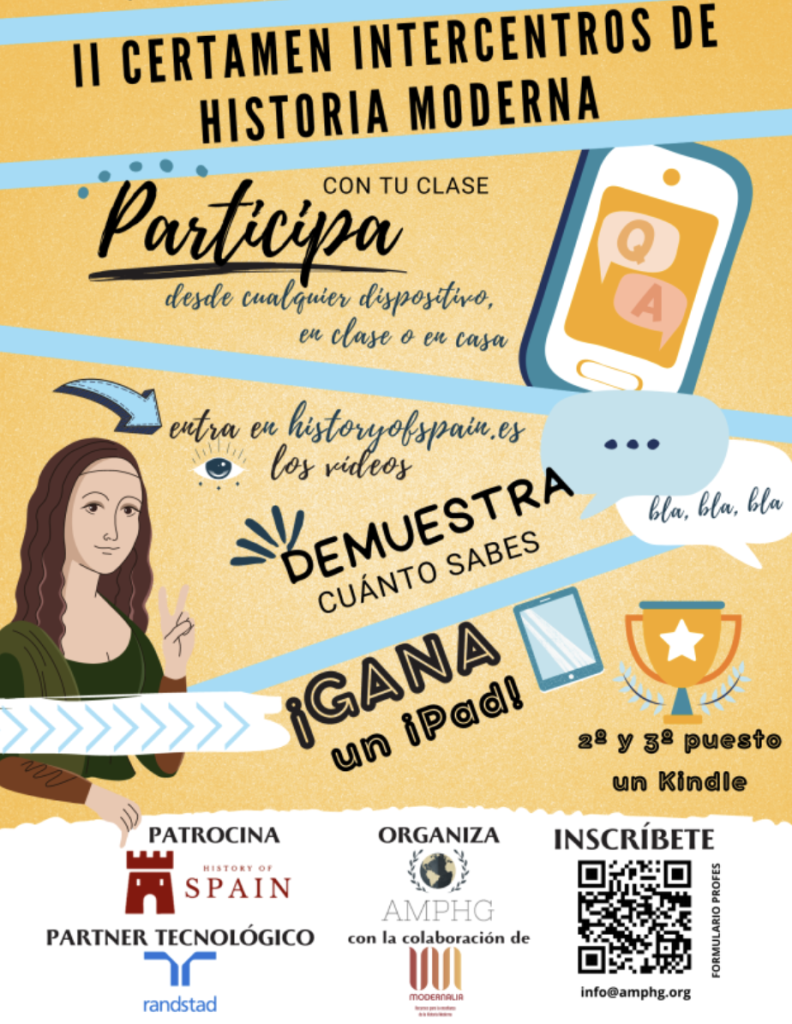
Take part in the 3rd Inter-School Modern History Competition
At the end of May this year, HistoryofSpain.com and the Madrid Association of History and Geography Teachers are organizing the 3rd Inter-School Modern History Competition.
The goal of this competition is for 2nd and 3rd year Secondary Education students from schools across Spain to demonstrate how much they know about Modern History through different quiz-style games, from multiple-choice questions to crosswords. Last year, more than 1,000 students took part. There are prizes for the winning students and their teachers.
To register, teachers must contact Isabel Velasco via the Association’s email: info@amphg.org