
Fame in art is a complex phenomenon, a mixture of technical genius and historical chance. What we now define as the canon of famous paintings of Spanish painting is not a static list, but a living organism that has evolved through centuries of collecting and critical revision. There is no single “Spanish school.” In this tradition, the darkness of tenebrism coexists with the dazzling light of the Mediterranean, and the rigid court portrait with the shattering cry of the avant-garde.
When analysing the famous paintings of Spanish painting, we face works that surpassed their own creators. These canvases have captured the collective imagination to define our cultural identity before the world. From the psychological depth of Velázquez to the luminosity of Sorolla, these masterpieces explain us better than any history manual.
1. Las Meninas – Diego Velázquez
Leading unquestionably the list of famous Spanish paintings, this work is more than a portrait; it is an intellectual labyrinth. In 1656, Velázquez executed a masterstroke by painting himself alongside the family of Philip IV, elevating painting from manual craft to the status of liberal art. The genius lies not only in the figure of Infanta Margarita, but in the dense atmosphere and in the play of mirrors that breaks the fourth wall. The spectator is drawn into the scene, inverting the logic of court portraiture. It is a painting that thinks, an instant capture that eternally questions the boundaries between reality and illusion.
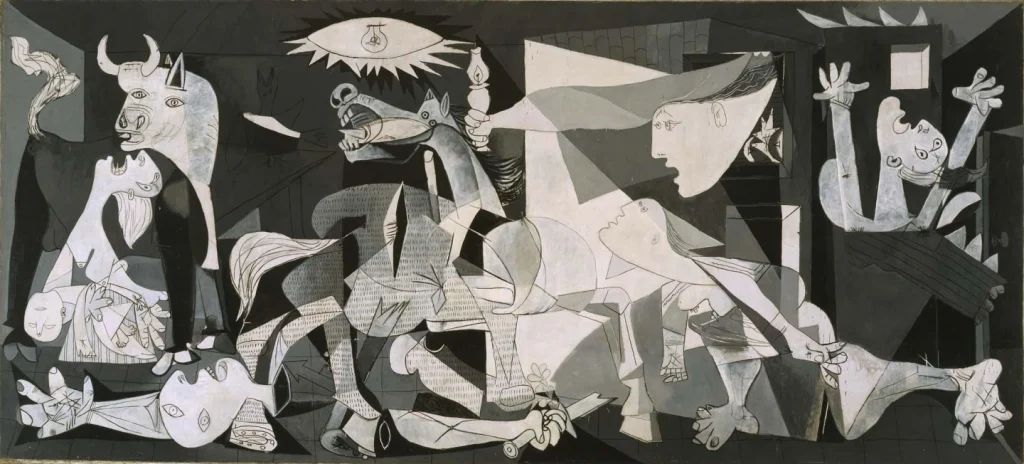
2. Guernica – Pablo Picasso
The 20th century is condensed in this mural, perhaps the most international of the famous Spanish paintings. Picasso responded to the 1937 bombing with a radical renunciation of colour, creating a journalistic grisaille of universal pain. The Cubist composition prevents linear reading and forces you to feel the chaos firsthand. Figures such as the eviscerated horse or the mother with her dead child are not mere characters but archetypes of suffering. It is not political propaganda, but a humanist cry that closed the era of traditional historical painting to inaugurate art as a tool of global conscience.
3. The Third of May 1808 – Francisco de Goya
If Velázquez painted diplomacy, Goya painted the slaughter. This canvas changed forever the course of the famous Spanish paintings by introducing social denunciation. There are no heroes, only an anonymous firing squad that acts like a faceless machine against a terrified populace. The lantern’s light on the ground is of a brutal expressionist violence, illuminating the man in a white shirt who raises his arms in a secular crucifixion. Goya does not seek idealised beauty; he seeks a visceral impact through blood and the fear of imminent death.
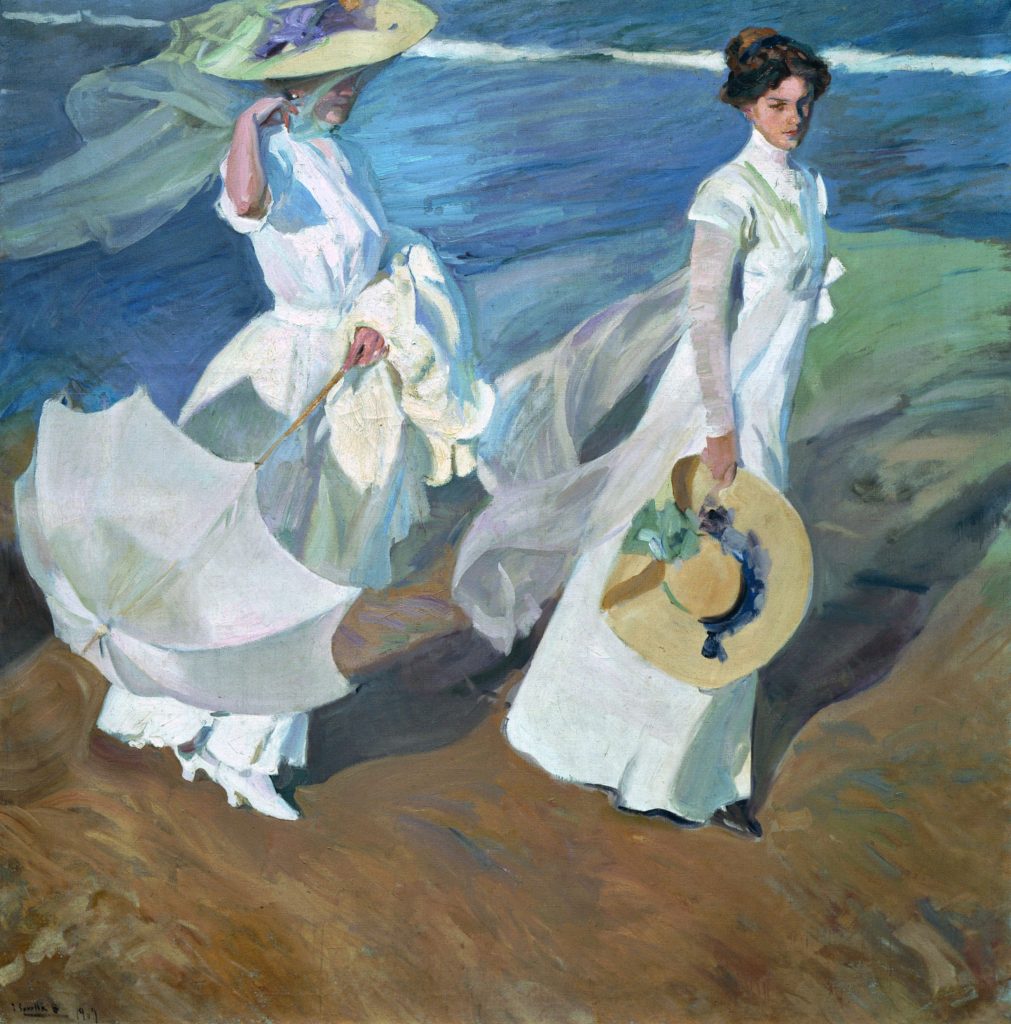
4. Walk on the Beach – Joaquín Sorolla
Sorolla is the luminous response to centuries of dark painting on the peninsula. This canvas is essential to understand the evolution of the famous Spanish paintings towards Luminism. The Valencian artist freezes a moment of breeze and sunlight, where the white of the dresses becomes the absolute protagonist, devouring form. There is no tragic or religious narrative, only the triumph of Mediterranean light and bourgeois elegance. It is a work that demonstrates that Spanish art also knew how to be optimistic, vital, and technically dazzling in its capture of movement.
5. The Persistence of Memory – Salvador Dalí
Fame often deceives regarding size, since this canvas is tiny, but its weight among the famous Spanish paintings is massive. Dalí here materialised the concept of the softness of time with an almost photographic academic technique. The visual unease arises from the contrast between the hyper-realistic landscape of Cape Creus and the decay of the melting clocks, devoured by ants. The artist defined the work as a “hand-painted photograph of dreams,” where memory ceases to be rigid and becomes edible and treacherous matter, bringing surrealism to the wider public.
6. The Nobleman with his Hand on his Chest – El Greco
For a long time, El Greco was misunderstood, but time has placed this canvas as one of the most iconic of the famous Spanish paintings. It has become the visual logo of the Spanish hidalguía. The identity of the portrayed is secondary; the vital element is the archetype. On a neutral background, the Cretan focuses tension on the melancholic gaze and the elongated hand with long fingers. This detail suggests a gesture of oath or honour. It is the triumph of psychological tenebrism, showing the dignity of a noble who stands only by his faith and his sword.
7. The Burial of the Count of Orgaz – El Greco
This monumental work alone summarises the Spanish Golden Age. Divided in two halves, it connects the earthly and the celestial in a composition that defies spatial logic. In the lower part, El Greco portrays the Toledan society of his time with astonishing realism, while the upper part explodes into an elongated, phosphorescent mysticism typical of Mannerism. It is one of the most complex of the famous Spanish paintings, where religious miracle coexists with group portraiture, demonstrating the artist’s ability to unite two worlds on one canvas.
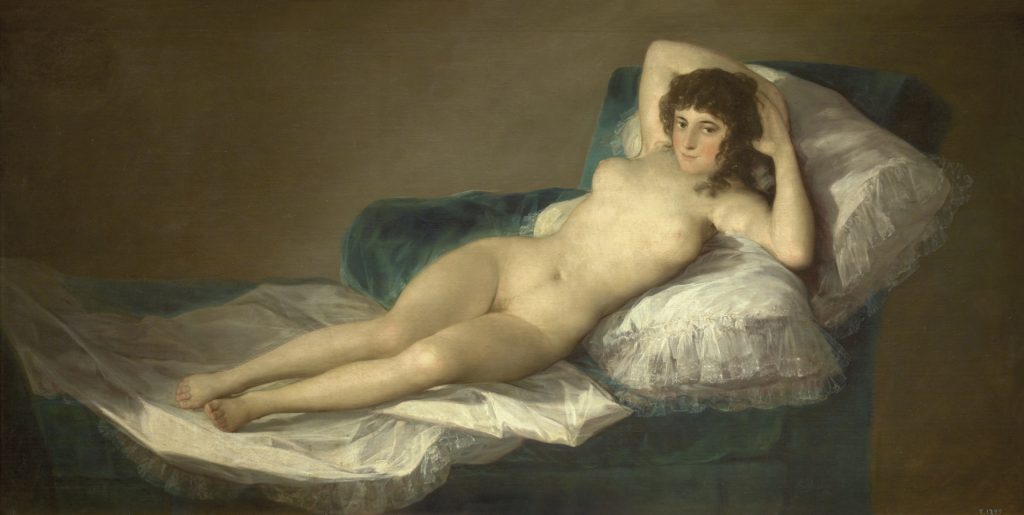
8. The Nude Maja – Francisco de Goya
This work was both scandal and offence. Hidden in Godoy’s private cabinet, it broke Western art’s great taboo by painting pubic hair without mythological excuses. That is why it is one of the most revolutionary of the famous Spanish paintings. The maja is a woman of flesh and bone who looks at us with a defiant frankness. Goya removed theatrical scenography to focus on skin texture and direct light. More than eroticism, the painting radiates radical modernity, functioning as a manifesto of private freedom in a restrained society.
► You may be interested in: The History of Spain in 10 Masterpieces of the Museo del Prado
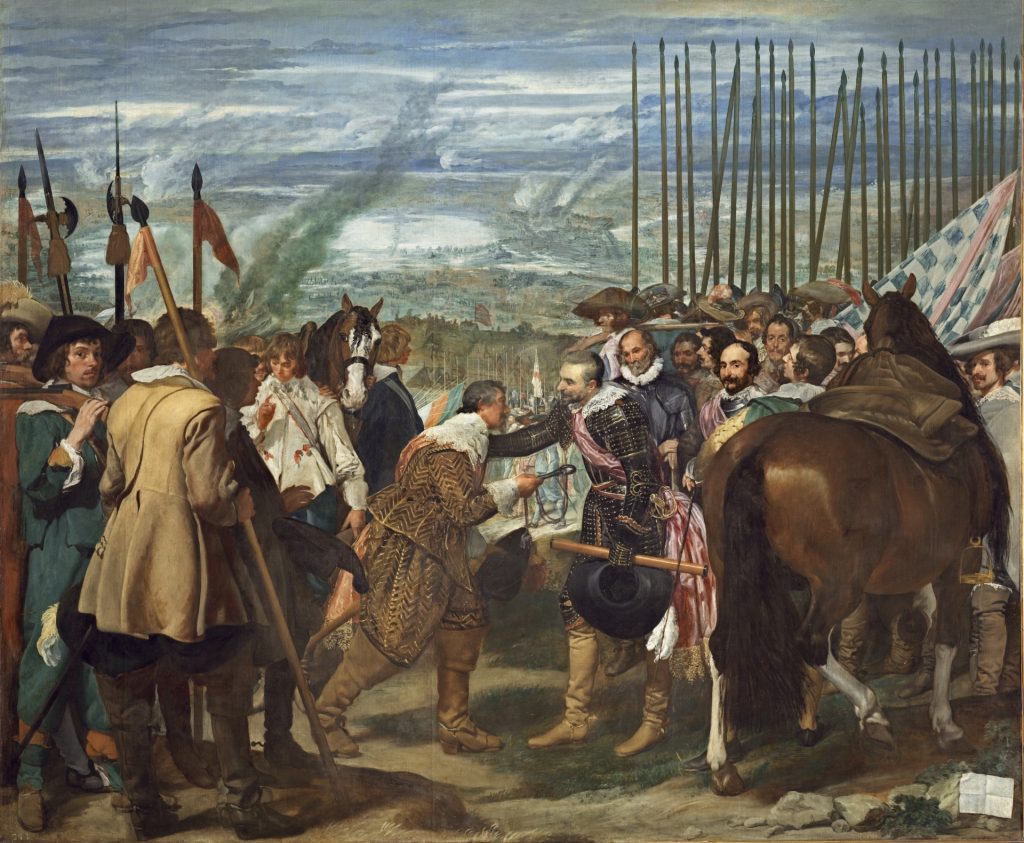
9. The Surrender of Breda – Diego Velázquez
Commonly known as Las Lanzas, this canvas is vital in the historical narrative of the famous Spanish paintings. Velázquez rewrote the war genre by avoiding the humiliation of the defeated. The gesture of General Spínola, placing a friendly hand on Nassau’s shoulder, conveys a unique image of chivalry. The technical mastery stands out in the aerial perspective of the background; with its airs and blues, it captures the atmosphere of the Netherlands with a truth that transcends mere political propaganda of the Hall of Realms.
10. Girl at the Window – Salvador Dalí
Before fully immersing himself in surrealist delirium, Dalí painted this masterpiece of serenity and balance. An essential figure among the famous Spanish paintings of the 20th century, it shows his sister Ana María from behind, looking out to the sea of Cadaqués. Here, the artist demonstrates his command of classical drawing and colour. Unlike his later dreamlike works, this painting invites silent contemplation and melancholy, connecting with realist tradition but filtered through a modern, blue-toned sensitivity that mesmerises the viewer.
Why the famous Spanish paintings continue to set a reference
The relevance of these works is not academic inertia. If the list of famous Spanish paintings remains a global reference, it is because our school prioritised truth over idealised beauty. Unlike the aestheticism of other traditions, Spanish art and its offshoots became obsessed with the real, even if it was uncomfortable or violent.
These ten canvases trace a clear line from political power to personal introspection. They are not mere decorative objects; they are notarial documents of our identity. Their fame endures because they are active mirrors that continue to interrogate contemporary viewers about authority, pain, and the human condition, demonstrating that the great masters still have much to tell us.