
When we think about the Spanish XIX Century, one image often comes to mind: a country that never stopped changing its mind. One day it wanted to be modern, the next it returned to old habits. It was as if Spain were a rebellious teenager, unsure of what it wanted to do with its future.
In just one hundred years, extraordinary things happened. Spain began the century invaded by Napoleon and ended it as a country with a constitution, a parliament, and railways. Along the way, there was everything: civil wars that tore families apart, revolutions that changed the nation’s direction, and political experiments that sometimes worked and other times ended in complete disaster.
What is most striking is how Spaniards at the time lived in constant uncertainty. They never knew whether the current government would last or if another military uprising would take place the very next day. Living like that must have been exhausting.
The Peninsular War (1808–1814)
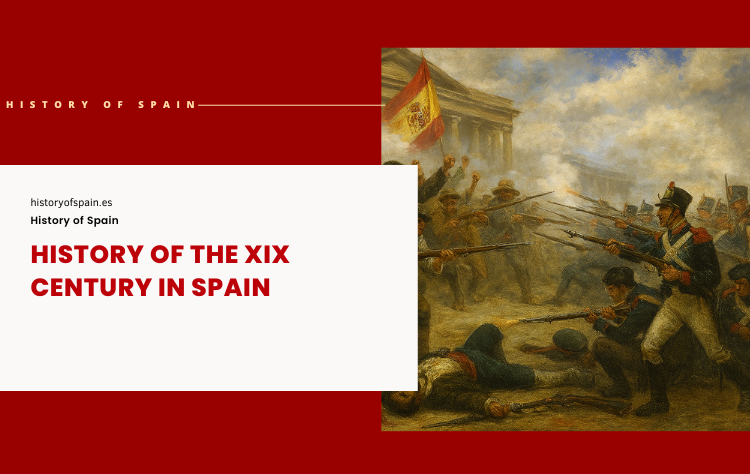
Everything began badly in 1808. Napoleon, who had already conquered much of Europe, decided that Spain should belong to him as well. He took advantage of the Spanish royal family’s internal conflicts to send in his troops. But something unexpected happened: Spaniards said “enough is enough” and rose up in arms.
This war was truly brutal. For six years, ordinary people became guerrilla fighters. Farmers who had never fired a shot in their lives hid behind rocks to ambush French soldiers. It was David versus Goliath, multiplied a thousand times over.
Goya painted the horrors he witnessed, and his works are chilling. But the most important part was not the battles themselves. For the first time, Spaniards began to feel truly Spanish. They were no longer just Aragonese, Castilians, or Andalusians. They were Spaniards fighting against an invader.
This war changed the country’s very DNA. Before, people obeyed the king without question. Afterwards, they began to think that perhaps the people also had a voice.
The Constitution of Cádiz of 1812
While the entire country was at war, something extraordinary was happening in Cádiz. It was one of the few cities the French had failed to capture, and there the remaining politicians gathered to do something revolutionary: write Spain’s first constitution.

The Constitution of 1812 was groundbreaking for its time. People called it “La Pepa” because it was approved on March 19, Saint Joseph’s Day. It introduced ideas that sounded almost futuristic: that power belonged to the people, not the king; that powers should be separated; and that the press should be free. It was as if Spain had leapt forward overnight.
When Ferdinand VII returned to the throne in 1814, the first thing he did was throw the constitution into the trash. But it was too late. The idea had taken root, and Spain could now imagine a different future.
Ferdinand VII, the king who played political ping-pong
Ferdinand VII was a character straight out of a movie. First, he ruled as an absolutist monarch, persecuting everyone who had supported the constitution. Then, in 1820, a colonel named Rafael del Riego led an uprising and forced him to swear loyalty to the constitution once again. This began the Liberal Triennium.
During those three years, Spain tried to become a truly modern country. Reforms were passed, the press was freed, and people began speaking openly about rights. But Ferdinand did not stand still. He asked his European allies for help, and in 1823 a French army arrived, restoring his absolute power.
What followed was the so-called “Ominous Decade“: ten years of total repression. Ferdinand took revenge on the liberals, closed universities, banned books, and turned Spain into a prison. It was as if the country had been pushed back fifty years overnight.
The Carlist Wars and the struggle over Spain’s political model
When Ferdinand VII died in 1833, Spain split in two. The question was who should rule: his daughter Isabella, a three-year-old child, or his brother Infante Carlos María Isidro.
But this was far more than a family dispute. The Carlists represented traditional Spain: deeply Catholic, opposed to change, and defenders of regional privileges. The supporters of Isabella stood for a liberal and modern country. It was as if two completely different Spains were fighting to the death.
The result was three civil wars that lasted for decades (1833–1840, 1846–1849, 1872–1876). The first was the bloodiest. The Carlists were especially strong in Navarre, the Basque Country, Aragon, and Catalonia. Stories from the time tell of families divided, even brothers killing one another.
These wars left deep scars on the country. The divisions between “the two Spains” never completely disappeared.
The reign of Isabella II and political instability (1833–1868)
The reign of Isabella II was a constant struggle. Every few years there was a military coup, a government fell, and a new constitution was written. Spanish generals had grown used to the idea that if they disliked something, they could simply overthrow it.
During these years, several constitutions came and went as if they were trading cards: the one of 1837, the one of 1845, and even another in 1856 that was never fully implemented. Figures such as Espartero, Narváez, and O’Donnell rotated in power, always after yet another uprising.
But it was not all coups. Spain also began to change internally. The first railways arrived, factories opened in Catalonia, and industry developed in the Basque Country. The bourgeoisie gained wealth and influence, while peasants continued living in poverty.
The first labor conflicts also emerged. Factory conditions were horrific, and workers began to organize. Socialist and anarchist ideas arrived from France, and the first unions appeared.
“La Gloriosa,” when Spain said “enough is enough”
In 1868, Spaniards finally reached their limit. The September Revolution, known as “La Gloriosa,” sent Isabella II into exile. But then came the question: what now?
First they tried an Italian king, Amadeo of Savoy. The poor man had no idea what he was walking into. He arrived in Madrid without allies, barely speaking Spanish, and with everyone against him. Republicans rejected him for being a king, monarchists rejected him for being foreign, and the Carlists continued their war. After two years, he fled back to Italy.
Then came the First Spanish Republic. In theory, it sounded wonderful: Spain would finally become a modern democratic republic. In practice, it was a disaster. Republicans fought among themselves, civil war erupted again, and some cities even declared independence. It was total chaos.
The Restoration, finally some stability
In 1874, General Arsenio Martínez Campos led the last major military coup of the century and restored the monarchy with Alfonso XII, the son of Isabella II. Antonio Cánovas del Castillo designed a political system meant to end decades of instability, beginning the period known as the Restoration.
The key was the so-called “peaceful turn” between two parties, the Liberal Party and the Conservative Party, which would alternate in power in an orderly way. It was somewhat of a sham, since elections were manipulated by local political bosses, but at least the coups came to an end. Politicians learned to change governments without guns.
This system brought stability for the first time in decades. The railway network was completed, more schools opened, industry expanded, and the first modern banks were created. Spain began to look like a normal European country.
But new problems also emerged. Workers organized into unions and began striking. Catalans and Basques developed their own nationalist movements. The gap between rich and poor widened. And women still had no political rights.
Legacy of the XIX Century in the history of Spain
By the end of the XIX Century, Spain was a completely different country. It had gone from being a medieval absolutist monarchy to a modern state with a constitution, parliament, a free press, and political parties. Not everything worked perfectly, but the foundations had been laid.
Spaniards had learned concepts that barely existed before: nationhood, citizenship, rights, and democracy. They knew how to vote, read newspapers, organize unions, and form political parties. Liberal ideas spread across the country, even as they coexisted with deeply conservative traditions.
It was a mad century, but in the end Spain achieved something that once seemed impossible: leaving the Old Regime behind and entering modernity. It came at the cost of blood and tears, but it happened. And it prepared the ground for the challenges of the twentieth century, which would not be easy either.
Among the most significant legacies of this century were:
- The definitive establishment of the constitutional state.
- The rise of parliamentary government and the first democratic experiments.
- The emergence of a civil society with new social classes: bourgeoisie, proletariat, and small landowners.
- The beginnings of the labor movement, which would strongly shape the twentieth century.
- The roots of regional nationalisms and the debate over Spain’s territorial model.
In short, the history of the XIX Century in Spain is the story of an intense, chaotic, and fascinating transformation. It was the century in which the country confronted itself, broke with its absolutist past, and laid the foundations of the modern political system. A turbulent period full of contradictions, but also of progress that permanently shaped Spain’s identity.
👉 If you want to keep discovering how our history was forged, don’t miss more articles on our blog specialized in the history of Spain.